
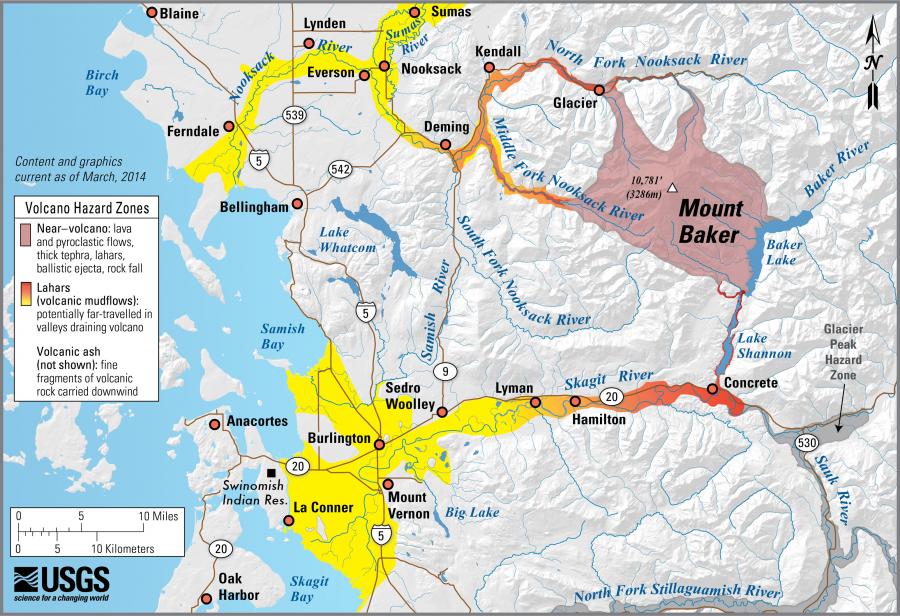
Mt. Baker is the closest Volcano to San Juan Islands. While our islands are not in danger of Lava Flows and Domes, Lahars, Volcanic Landslides or Pyroclastic Flows, we will likely experience fallout from Volcanic Ash. It’s good to know about the risks just in case you are on a Costco Run or running errands. Most volcanos give warning before eruption, because when magma rises towards the surface, it normally generates detectable earthquakes.
Read More Below.
Eruption Columns and Clouds
When a volcano erupts, the blast sends gas and pieces of molten rock into the air. Lighter pieces, such as volcanic glass, minerals, and ash can rise high into the air and form a massive cloud called an eruption column. The larger pieces—called volcanic bombs—usually fall quickly to the ground with a few miles of the volcanic vent. All of these pieces of ash, bombs, and rock fragments produced during the eruption are known as tephra.
When eruption columns become large, they pose a serious hazard to health and aviation. The small particles of dust, rock, and volcanic glass—called ash—can be inhaled and cause lung damage. Ash is also damaging to airplanes if they fly through the ash cloud.
Eruption columns and ash clouds can become enormous and extend for hundreds of miles. The 1980 eruption of Mount St. Helens covered over 22,000 square miles with ash. This is considered to be a relatively small volcanic eruption. Larger eruptions, such as the 1883 eruption of Krakatoa in the south Pacific, produced enough ash to slightly lower the temperature of the entire earth for several years.
Volcanic Gas
Volcanoes release gas both during eruptions and between eruptions. During eruptions this release can be very explosive and is often what propels the ash and rock into the air. As magma is formed deep in the earth, it contains small amounts of gas under very high pressure. As the magma moves towards the surface, the gases try to expand but may not be able to if the magma is very thick (viscous). When the volcano erupts, it is like opening a soda can that has been shaken up!
Between eruptions, much of the gas a volcano creates is steam. This steam is made when groundwater interacts with the hot interior of the volcano. The steam rises through cracks and can eventually reach the surface. At the surface it can form fumaroles, mud pots, or hot springs. The rising steam can also melt snow or ice, potentially causing lahars or landslides.
In addition to steam, volcanoes can also release more dangerous gas, such as carbon dioxide, sulfur dioxide, hydrogen sulfide, hydrogen, and fluorine. These gases can react with water in the air to create acid rain. Heavy gas, such as carbon dioxide, can be trapped in low-lying areas and suffocate animals or people.
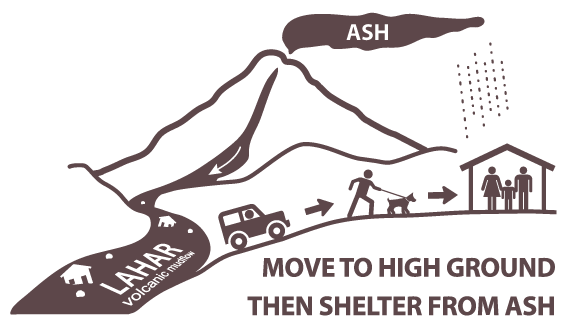
If THERE IS ASHFALL…
Protect your lungs!
Volcanic ash is made of microscopic shards of glass and other fine-grained material. Ash can can cause significant damage to animals, including significant damage to lungs or asphyxiation if inhaled.
For more information about ash fall, check out the USGS Volcanic Ash website.
If there is falling ash and you cannot evacuate, remain indoors with doors, windows, and ventilation systems closed until the ash settles.
Help infants, the elderly, and those with respiratory conditions.
Wear a respirator, face mask, or a use a damp cloth across your mouth to protect your lungs.
Use goggles, and wear eyeglasses instead of contact lenses.
Avoid driving in heavy ash fall unless absolutely required. If you must drive, reduce your speed significantly.
Avoid operating engines of any kind. Ash can clog engines, damage parts, and stall vehicles.
Wear long-sleeved shirts and long pants.
Keep roofs free of ash in excess of 4 inches.
Limit outdoor activity. Remove outdoor clothing before entering a building.
Check to ensure that ash does not contaminate your water. If it does, use a different source, such as bottled water.
Information Source: www.DNR.wa.gov