
Seaweed Futures in the North Pacific: Climate, Food, and Coastal Resilience
Across the North Pacific, seaweed and kelp aquaculture is emerging as a cornerstone of a climate-positive blue economy linking Alaska, Canada, and Washington State. Kelp requires no freshwater, fertilizer, or arable land, while rapidly absorbing carbon and excess nutrients, making it uniquely suited to climate adaptation and mitigation strategies (NOAA Fisheries, n.d.).
In Alaska, cold, nutrient-rich waters support commercial cultivation of sugar kelp, bull kelp, and ribbon kelp. Companies such as Seagrove Kelp Co. have helped grow Alaska’s mariculture sector from near zero a decade ago into a recognized industry providing winter income, local food, and raw materials for fertilizer and bioproducts, while also improving nearshore water quality and ecosystem productivity (Alaska Beacon, 2023; Alaska Mariculture Alliance, n.d.).
In Canada, particularly British Columbia, seaweed farming is advancing rapidly through Indigenous-led enterprises, research partnerships, and strong public investment. In November 2025, Canada committed $15 million to accelerate seaweed cultivation, restoration, and processing capacity, recognizing kelp’s role in carbon sequestration, shoreline protection, and climate-resilient coastal economies (Canada’s Ocean Supercluster, 2025).
In Washington State, kelp farming remains small but strategic. Only a few fully permitted commercial operations exist, including Blue Dot Sea Farms and Lummi Island SeaGreens in Lummi Bay, pioneering sugar kelp production alongside shellfish. These farms demonstrate how kelp can complement existing aquaculture while supporting nutrient cycling and habitat complexity in Puget Sound waters (Cascadia Daily News, 2024; University of Washington, 2023).
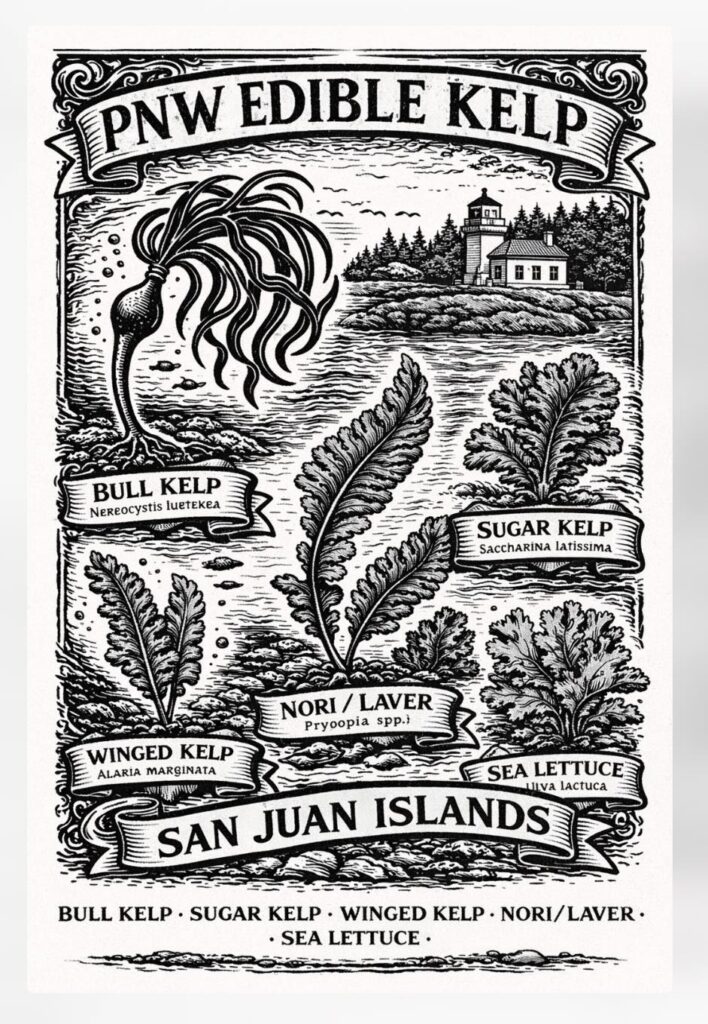
The San Juan Islands represent a logical next frontier. The region’s clean, well-flushed waters, strong tidal exchange, and native kelp presence mirror successful growing conditions in Alaska and British Columbia. Regional recovery plans identify kelp as a priority climate habitat, critical for supporting forage fish, salmon, and orcas while buffering ocean acidification (Puget Sound Partnership, 2021; WDFW, 2022). Existing permitting pathways through WA DNR, Ecology, and WDFW provide a defined regulatory framework. With careful siting and community partnerships, the San Juan Islands could become a model for community-scaled, climate-smart kelp aquaculture, strengthening food security, coastal economies, and ecosystem resilience simultaneously.
References
Alaska Beacon. (2023). Seaweed farming inspires high hopes in Alaska for economic and environmental benefits. Juneau, AK.
Alaska Mariculture Alliance. (n.d.). Alaska mariculture development plan and seaweed aquaculture overview. Anchorage, AK.
Canada’s Ocean Supercluster. (2025, November). Canada’s Ocean Supercluster announces $15.5 million seaweed restoration and cultivation project. Halifax, NS.
Cascadia Daily News. (2024). Washington’s first commercial kelp farms navigate early harvests and permitting challenges. Bellingham, WA.
National Oceanic and Atmospheric Administration (NOAA) Fisheries. (n.d.). Seaweed aquaculture in the United States. U.S. Department of Commerce.
Puget Sound Partnership. (2021). Puget Sound recovery plan: Kelp and eelgrass recovery targets and implementation strategies. Olympia, WA.
University of Washington School of Marine & Environmental Affairs. (2023). Exploring kelp farming in Washington State: Opportunities and constraints. Seattle, WA.
Washington State Department of Ecology. (2021). Shoreline Management Act guidance for aquaculture and marine restoration projects. Olympia, WA.
Washington State Department of Natural Resources. (2022). Aquatic lands leasing and permitting for commercial aquaculture in Washington State. Olympia, WA.
Washington Department of Fish and Wildlife. (2022). Kelp and eelgrass monitoring and conservation in the Salish Sea. Olympia, WA.